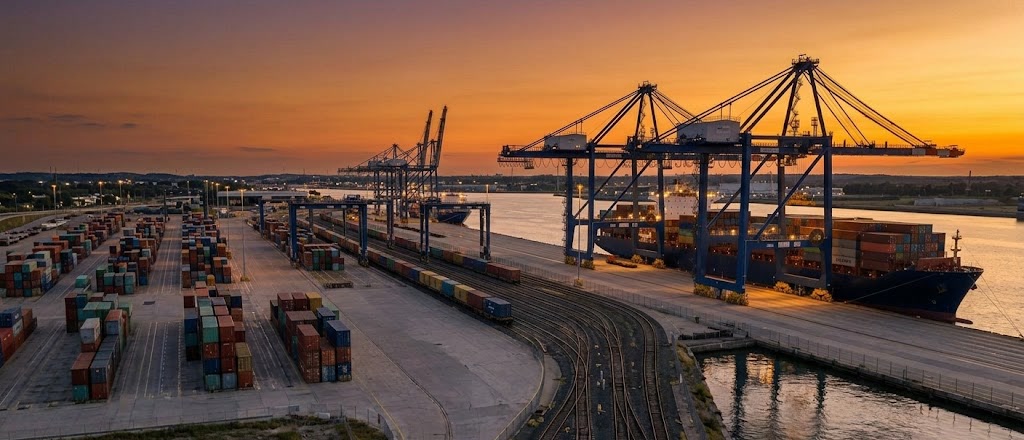
The figures that hold up the case
International rail share, port traffic, commissioning of the Pajares Bypass and business demand from the Spanish northwest. We compare the evolution of rail traffic with port traffic to gauge the opportunity cost of the corridor delay.
Rail share · Port of Gijón (2024)
4.07%
Of every 100 land-based tonnes at the port, only 4 leave by rail. −46.9% vs 2019 — an all-time low in the OFE series: the ports are left stranded without rail.
3.800 M€
Pajares · investment executed
Pajares Bypass (León–Pola de Lena HSL), in service since 29 Nov 2023.
3.100
Freight trains · Pajares 2024
52.5% of all movements through the tunnel; +28% in 2025.
4 M€
Downstream · works awarded
Only the Oviedo–Gijón drafting (32 km) out of ~€68 M estimated. Works not yet tendered.
0.7%
Intl. rail share · Spain
On tonnes in international traffic 2024 (OTLE Edition XIII).
Evidence · the three territories
One maritime axis, opposite rhythms: the ports of the north-west Atlantic Corridor
Asturias and Galicia share the corridor's maritime frontage. The paradox is glaring: the smallest port —Marín— has Spain's 2nd-highest rail modal share (behind only Santander), while Vigo, the largest in containers, ships nothing by rail, and the Langosteira basin, the one with the most tonnage, still has no rail connection. This is not an Asturian challenge alone.
| Port | Territory | 2024 traffic | Δ 24/23 | Containers | Rail share | TEN-T network |
|---|---|---|---|---|---|---|
| Port of Gijón | Asturias | 15.88 Mt | -17,2% | 71,852 TEU | 4.07% | Core network · 2030 |
| Port of A Coruña | Galicia | 14.69 Mt | +5,1% | 34 TEU | 1.37% | Core network · 2030 |
| Port of Ferrol-San Cibrao | Galicia | 6.67 Mt | -21,1% | 14,209 TEU | 0.00% | Comprehensive network · 2050 |
| Port of Vigo | Galicia | 5.50 Mt | +14,0% | 298,005 TEU | 0.01% | Comprehensive network · 2050 |
| Port of Avilés | Asturias | 4.65 Mt | +1,5% | — | 1.48% | Comprehensive network · 2050 |
| Port of Marín and the Ría de Pontevedra | Galicia | 2.57 Mt | +21,3% | 48,255 TEU | 13.93% | Comprehensive network · 2050 |
Tonnage: OPPE Statistical Yearbook 2024 (final figures). Rail share: % of the port's land-based traffic moved by rail (Observatorio del Ferrocarril en España, OFE 2024, now published port by port). Containers in TEU.
Galicia · what each port is made of
Same frontage, opposite cargoes
The breakdown by cargo type (2024) explains the rail paradox. A Coruña lives off liquid bulk (Repsol, in the outer basin still without rail); Vigo is almost entirely general cargo —automotive and containers—, precisely the freight most suited to rail that today travels by road; Marín splits dry bulk and general cargo, and is the only one moving a meaningful share by rail.
The inland axis · León
The dry port that never arrives, and the spur that does work
León is the corridor's inland hinge between the Meseta and the northern ports. But its major logistics node —the Torneros dry port— has been on the drawing board since 2010 without being built, while the north-west freight axis concentrates in Valladolid. The most tangible intermodal case today is a steel-industry spur linking to the Port of Gijón.
Torneros-Grulleros Logistics Platform
Planned / not yet tenderedThe "León dry port": ~198 ha next to the León-Palencia line, promoted by SEPES. Planned since 2010, development not yet tendered; the rail terminal is not in the initial phase.
La Placa Intermodal Platform (Ponferrada)
Planned / not yet tenderedTerminal on line 800, conceived as a dry port toward A Coruña, Vigo, Ferrol and Madrid (€19.4 M). Not tendered; explicit backing from the Castilla y León regional government.
Villadangos del Páramo Terminal
OperationalThe most tangible intermodal case around León: a steel branch (Network Steel, ~400,000 t/year expected) connected to the Port of Gijón. €20.5 M invested.
León Mercancías Terminal
Operational, underusedADIF intermodal terminal (operated by Transfesa+Slisa since 2020). Small scale (~1,600 ILUs/half-year in 2019), well below the TEN-T threshold of 800,000 t/year.
328,099 t
León → Galicia by rail (2020). The flow exists east-to-west, but the return is almost nil: a deeply asymmetric corridor.
359,946 t
Asturias → León by rail (2020): the second origin of the freight reaching Castilla y León. The evidence of the León-Gijón corridor north-to-south.
Eurostat tran_r_rago (NUTS 2), 2020 — five-yearly series, latest year available. ES41 = the whole of Castilla y León.
Regional rail, in retreat
Where Europe wants to double rail freight, the north-west is losing it
Tonnes loaded by rail in each region —the only official regional figure—. Between 2015 and 2020, the latest year published by Eurostat, Galicia lost a third of its rail freight and Castilla y León more than a quarter. The axis is not merely underused: it is shrinking, in the exact opposite direction to the European goal of doubling rail freight by 2050.
Galicia · freight loaded by rail
tonnes/yearChange 2015 → 2020: -35.9%
Castilla y León · freight loaded by rail
tonnes/yearChange 2015 → 2020: -28.6%
Freight unloaded falls even further: −40.6% in Galicia and −33.9% in Castilla y León between 2015 and 2020. Tonnes loaded/unloaded by rail in each region. ES41 = the whole of Castilla y León (Eurostat does not break down to the province of León). Five-yearly series; the regional figure has not been updated since 2020.
FuenteMITMA · OFE· dic 2025OEPB · Puertos del Estado· dic 2024RTPA· ene 2025Puertos del Estado· oct 2025Eurostat· ene 2023MITMA· dic 2023Diario de León· dic 2024El Mercantil· dic 2024
€3,800 M in the Pajares Bypass, and freight demand is already there.
The Pajares Bypass — the León - Pola de Lena high-speed line with two 24.6 km base tunnels — entered commercial service on 29 November 2023. Since then, reality already exceeds the official forecast: nearly a million Madrid-Asturias passengers and, above all, 3,100 freight trains (52.5% of all movements through the tunnel), accelerating by +28% in 2025. The northern end of the Corridor is paid for and proves real demand.
But downstream, Pajares flows into a commuter-rail project.
Everything leaving the northern mouth of the Bypass runs down line 130 (Pola de Lena – Gijón, 73 km) — the only corridor connecting the northern exit of Pajares with Mieres, Oviedo, the Asturian triangle (Villabona-Lugones-Serín), Gijón and, via Avilés, the ports. It is the industrial backbone of Asturias and of the peninsular interior. The only work tendered on this stretch is a renewal of the Oviedo – Gijón C1 commuter line of ~€68 M estimated — and so far only €4 M awarded to draft the project. It is not a freight work, not a European standard, not a corridor.
FuenteADIF· jul 2025
For every 100 tonnes entering through Gijón, only 4 leave by rail — and Avilés posts the steepest maritime-rail decline in Spain.
The two Asturian ports move around 20 million tonnes a year and are the maritime end of the Atlantic Corridor. With no European-standard rail network downstream of Pajares, what arrives and leaves by ship stays on the truck. The OFE series documents it since 2015: Gijón has gone from 12.94% to 4.07%, Avilés from 5.6% to 1.48%. Gijón's 2024 fall is energy transition (coal), but the freight that is growing — containers and liquid bulk — is precisely the kind that would most need rail.
Total traffic — Port of Gijón
tonnes/yearChange 2023 → 2024: -17.2%
Total traffic — Port of Avilés
tonnes/yearChange 2023 → 2024: +1.5%
- 2024: All-time record (RTPA / APA).
Rail modal share — Port of Gijón
% land accessRail modal share — Port of Avilés
% land accessFuenteDiario El Canal· feb 2023OEPB · Puertos del Estado· dic 2024Autoridad Portuaria de Avilés· dic 2024RTPA· ene 2025Autoridad Portuaria de Gijón· dic 2025MITMA · OFE· dic 2025Transporte XXI· sep 2024
While Europe seeks to shift freight onto rail, Spain's international rail share drops to 0.7% — and the region ends up at the wrong end of the map.
A European corridor is justified by its capacity to move international freight. But in Spain, according to OTLE Edition XIII, rail moves barely 0.7% of international tonnes — versus 21.4% for road and 77.7% for shipping. And it is getting worse: since 2019 road's international share has risen by +1.8 pp while rail's has fallen -0.1 pp. Without a genuinely capable north-west corridor, that shift is impossible from the western end of the peninsula — and Asturias, with its ports and its businesses, pays the bill for the inconsistency.
Modal split of international freight transport in Spain — 2024 (% of tonnes)
%- Rail0.7%
Target mode of the Atlantic Corridor. -0.1 pp vs 2019.
- Air0.2%
Stable share since 2021.
- Road21.4%
+1.8 pp vs 2019. Rising while rail falls.
- Maritime77.7%
Dominant mode. -1.8 pp vs 2019.
Rail modal share — international comparison (% of land transport)
%- Gijón4.07%
Rail share of the port's land traffic in 2024 (OFE).
- Avilés1.48%
Rail share of the port's land traffic in 2024 (OFE).
- Spain3.9%
National rail share in land t-km (2024). Falling from 4.2% in 2023.
- Spain 2030 target10%
MITMA Mercancías 30 Plan goal (€8,442 M committed by 2030).
- EU-2716.6%
Average of the 27 EU countries in land t-km (2024).
- Austria30%
Austria and Lithuania exceed a 30% rail modal share.
FuenteMITMA · Observatorio del Transporte y la Logística en España· abr 2026MITMA· dic 2024Eurostat· mar 2025MITMA· jul 2023CNMC· jul 2025
Cercanías Asturias: sixth-largest network in Spain
After the peak of 7.3 million passengers in 2023 — driven by free season tickets — the network falls back to 6.7 million in 2024, still well above the pre-pandemic level. The Cercanías Asturias 2017-2030 Plan (MITMA, 15 Feb 2024) commits €1,586 M, of which €458 M is rolling stock: 35 new metric-gauge trains began manufacturing in February 2024.
Cercanías Asturias passengers — OFE series
passengers/yearChange 2023 → 2024: -8.2%
Asturias is Spain's sixth-largest commuter (Cercanías) network. After the 2023 peak (driven by free season tickets), 2024 falls back by 8.6%. The service remains well above pre-pandemic levels.
FADE, CEG and FELE call for €8,000 M so as not to lose the Atlantic Corridor
In December 2023 the business federations of Galicia, Asturias and León, backed by CEOE, quantified for the first time the cost of not completing the corridor: €7,884 M of additional investment (rounded to €8,000 M in the public statement) to triple regional rail traffic toward the 2040 horizon. The demand complements the investment MITMA has already committed in Asturias for this programme.
01Investment demanded
7,884 M€
Galicia + Asturias + Castilla y León. Signed by CEG, FADE, FELE and CEOE.
02MITMA · Asturias Corridor
2,800 M€
Investment committed 2024-2030
03NW rail traffic
7 → 20.4 Mt
Projection to the 2040 horizon per the business study.
04Employment impact
23,900
Associated jobs · +€4,500 M GDP by 2040
The argument behind the figures
These series underpin the case for the corridor: what Europe requires, where the network fails and what we ask for.
Every figure links to its official source
Sources, criteria and limitations of each figure in the monitor on the methodology page.
Main sources: OFE — 2024 Report (MITMA) · OTLE Edition XIII 2025-2026 (MITMA)